
When a person’s heart stops, they are, by every standard clinical measure, considered dead. Some of those people are brought back, and some of them describe what happened while they were gone. Doctors have written those accounts down, studied them, and in a few cases tried to test them under controlled conditions.
This article stays in the hospital room, with what doctors and nurses have actually written down. It looks at what doctors have recorded about cardiac arrest, what survivors say afterward, how researchers have tried to check those stories, and where the evidence stops. If you want the bigger picture about the debate between science and spiritual belief, I cover it separately in scientific explanations vs. spiritual perspectives on NDEs. In this article, I will stick to the medical record.
What happens in the body when the heart stops
A cardiac arrest is not the same as a heart attack. In a heart attack, a blocked artery damages the heart muscle, but the heart usually keeps beating. In a cardiac arrest, the heart’s electrical rhythm fails and it stops pumping effectively. Blood pressure falls and blood stops reaching the brain.
The brain has almost no oxygen reserve, so it reacts fast. A person typically loses consciousness within seconds, and the electrical activity measured on the scalp drops to a flat or nearly flat line soon after. Breathing stops or becomes gasping. The pupils widen and there is no pulse.
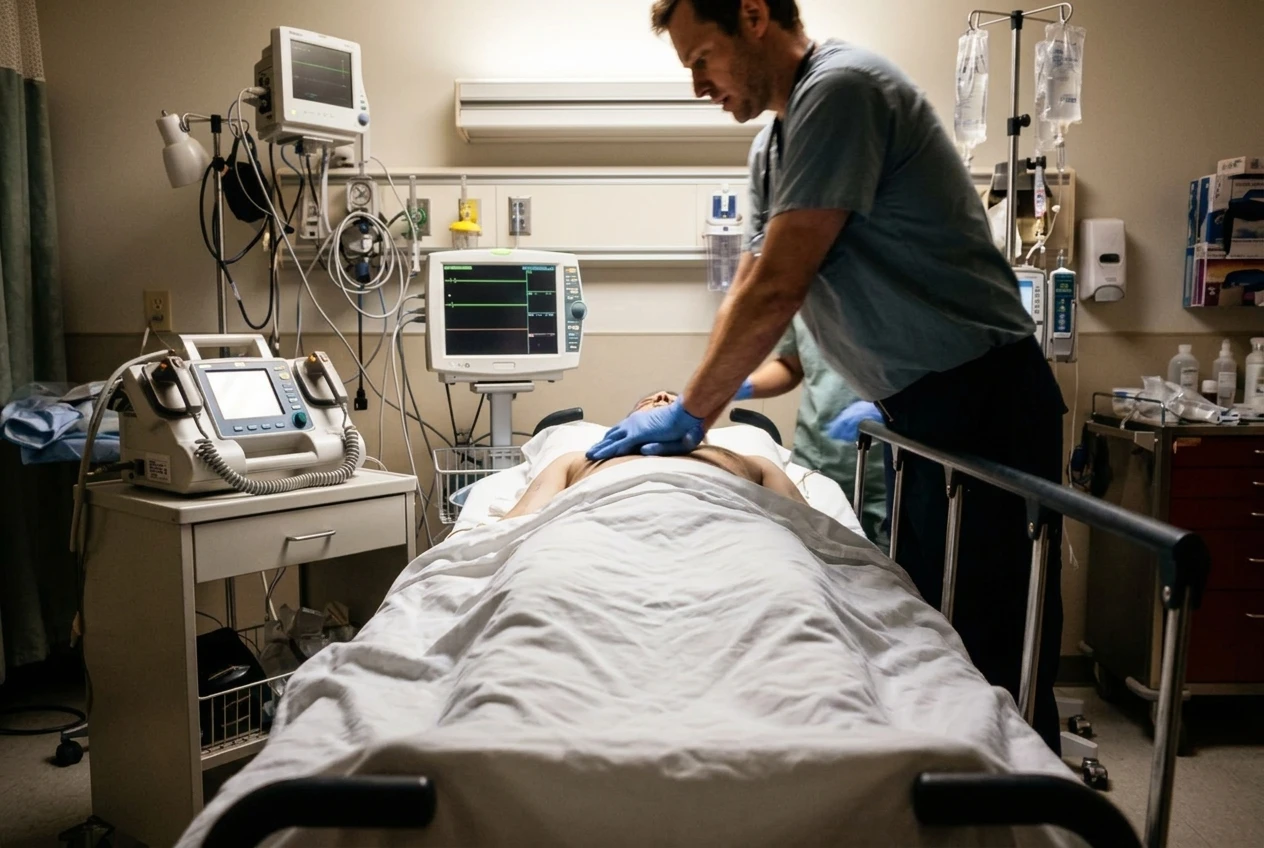
Brain cells do not die the instant the blood stops. Injury builds over minutes without circulation, which is why CPR and defibrillation are urgent. Chest compressions push some blood to the brain, but only a fraction of normal flow, and the amount varies with how well the compressions are done.
That timeline matters for everything that follows. If a person recalls something afterward, the questions are when it happened and what the brain was doing at that moment. Those questions are harder to answer than they sound.
Why cardiac arrest became the place researchers look
Near death experiences happen in other situations too, including accidents, serious illness and childbirth complications. Cardiac arrest became the focus for several practical reasons.
- It has a clear start and end time.Teams usually record when the heart stopped and when circulation returned, so there is a documented stretch of time to study.
- It happens under observation. In a hospital, nurses, doctors and monitors are already present, so the event is written down as it unfolds.
- The physiology is severe. If the brain is as impaired as it appears, any organized memory from that period is surprising and worth examining.
- More people survive than before. Better resuscitation methods mean more patients who came close to death can be interviewed afterward, which gives researchers a larger group to study.
Cardiac arrest also lets researchers prepare in advance. Hospitals know which wards see the most cardiac arrests, so a study can be planned before anyone is admitted. That is nearly impossible with a car crash, which no one can predict.
What survivors report afterward
Researchers do not rely on free-form storytelling alone. They usually ask structured questions. The best-known tool for structured questions is the Greyson NDE Scale, a 16-item questionnaire. It asks things like whether time seemed to speed up, whether the person felt separated from their body, whether they felt peace, whether they met other beings, and whether they felt they had come to a border of no return. A score of 7 or higher out of 32 is the usual threshold for calling an experience a near death experience.
According to the studies, the reported elements are fairly consistent: a sense of peace, a feeling of leaving the body and watching the scene from above, a bright light, meeting deceased relatives, a review of life events, and a sense of a boundary. I go through these in more detail in my post on common themes in near death experiences.
Not everyone reports the same thing, and not every report is a happy one. Some survivors describe fear or confusion rather than peace. And many remember nothing at all from the time their heart had stopped. In most studies, those people are the biggest group.
That last point is easy to lose. The studies tell us what a minority of survivors recall. They also tell us that most survivors recall nothing.
How researchers try to test whether these reports are real
There are two separate questions here. One is whether people really have these experiences, and the answer from the clinical record is yes: they report them consistently, and they are not rare. The other is whether what they report matches what was physically happening around them, which is much harder to settle by.
Prospective studies. Most early work was retrospective, meaning people were asked years later. A prospective study enrolls patients as they are resuscitated and interviews them soon after, which reduces the chance that memories change over time. A well-known Dutch study published in The Lancet in 2001, led by cardiologist Pim van Lommel, followed 344 cardiac arrest survivors across several hospitals. About 18 percent reported some memory from the period of arrest, and about 12 percent described a core near death experience.
Checking accounts against records. In a few cases, researchers compare what a patient says with what staff documented, such as who was in the room or what equipment was used. This works only when the staff record is detailed and the patient did not hear the story from someone afterward.
Hidden targets. The AWARE study, led by Sam Parnia and published in 2014, took place in several hospitals and examined over 2,000 cardiac arrests. In some resuscitation rooms, shelves were mounted high up near the ceiling, with pictures placed on them that could only be seen from above. The thinking was straightforward: if a person’s awareness really did float above the bed, they might be able to name a picture they had no ordinary way of seeing. When a follow-up, AWARE II, was published in 2023, it used a similar setup with tighter controls.
The hidden target approach did not give clear answers. Very few cardiac arrests happened in the rooms that had the shelves, and most patients did not survive. Of those who did, only a few were well enough to be interviewed. In the first study, no survivor correctly named the pictures. In the follow-up, I am not aware of any confirmed case where a patient correctly described the hidden images, and only a small number of survivors could be tested.
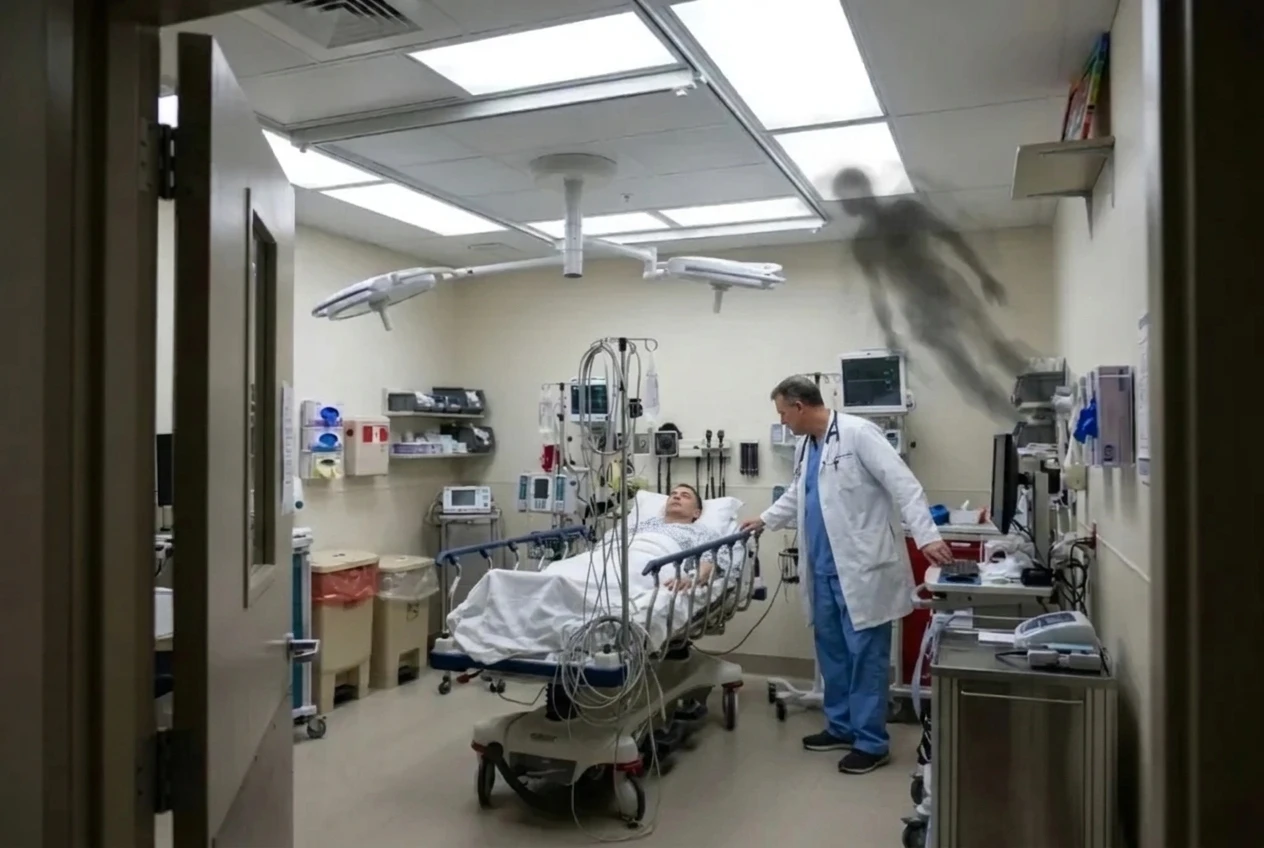
One case in AWARE did draw attention. A survivor described events from the resuscitation, including the automated voice of a defibrillator, and the research team judged the timing consistent with a point a few minutes into the arrest. It is a single account, so it can be read as intriguing or as insufficient, depending on how you weigh it.
What the studies can and cannot tell us
Here is what I think the clinical record supports.
- Experiences with a consistent set of features are reported by a meaningful minority of cardiac arrest survivors.
- Those reports show up across hospitals and countries, and they can be measured with standard questionnaires.
- The dying brain is not simply switched off. Animal studies, including a 2013 study in rats from Jimo Borjigin’s group, found a surge of organized electrical activity after the heart stopped. Later work reported similar changes in a small number of dying human patients. These findings are early, involve very few people, and no one has shown they match what any survivor remembers.
Here is what the studies still cannot tell us, in plain terms.
- When the experience happened. A survivor who remembers something cannot say exactly when it happened. It could have been while the heart was stopped, while doctors were getting the blood flowing again, or while the person was waking up. A memory formed in the minutes after resuscitation can easily end up placed at the wrong moment.
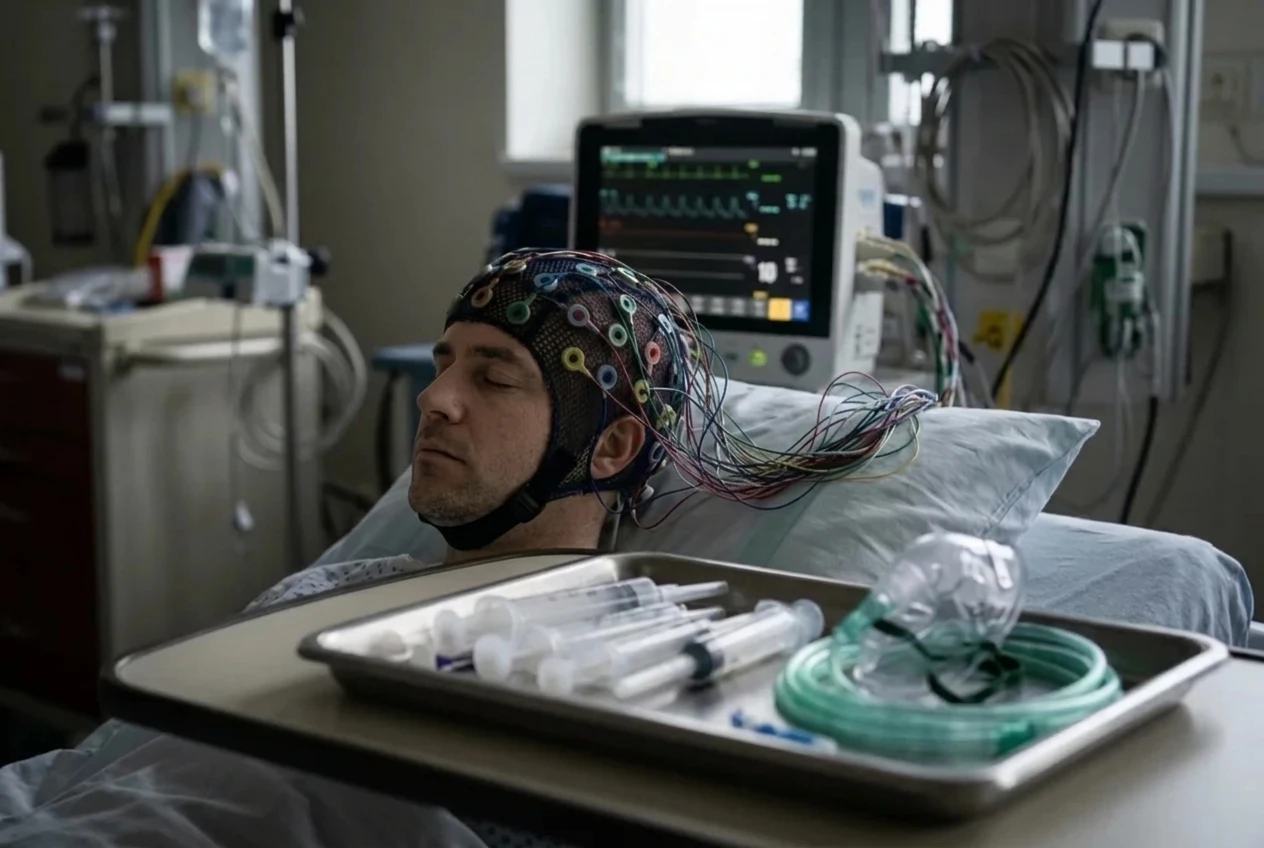
- Whether the brain was fully inactive. Scalp EEG measures surface activity. A flat line there does not prove that no activity remained deeper in the brain.
- What drugs, oxygen levels and sedation contributed. Patients in arrest and recovery are often getting medication, and their blood chemistry is abnormal. Those factors are hard to separate from the experience itself.
- Whether the sample is representative. Studies depend on survivors who are well enough to be interviewed and who agree to take part. Most people who arrest do not survive.
The hidden target method also has a built-in limit. A negative result from a few hundred survivors in a small number of rooms does not show that such perceptions never happen, and it does not show that they do. It shows that this particular test has not produced a clear positive so far.
Why doctors still disagree about what it means
Researchers looking at the same records reach different conclusions, and the disagreement usually comes down to which gaps they treat as most important.
One group of doctors argue that these experiences are produced by a brain under extreme stress. They point to low oxygen, shifts in brain chemistry, the electrical surge seen in animal studies, and the way memory is reconstructed after trauma. In this view, the experience is real as an experience, but it comes from the brain, and the consistency across cultures reflects shared biology.
Another doctor group, including van Lommel, argues that organized, clear experiences during a period of profoundly reduced brain function are hard to fit into that model. They suggest consciousness may not depend entirely on normal brain activity. Parnia has been more cautious in how he frames his own conclusions, and has argued that these accounts deserve serious study with better tools rather than dismissal.
Some of the disagreement is simply about words. People use “flatline,” “clinical death” and “brain death” as if they meant the same thing, but they do not. Clinical death means the heart and breathing have stopped, and it can sometimes be reversed. Brain death is something else: the brain has stopped working for good and cannot recover. None of the cardiac arrest research is about brain death.
Culture and expectation also play a role in how people describe what they remember. I look at that in how cultural background influences NDE interpretation. Even a patient who remembers a clear experience will describe it with the vocabulary they already have.
How to start reading the research yourself
You do not need a medical degree to read these papers, but a few habits make it easier.
- Start with the summary, then go straight to the “methods” section. The methods section tells you how many people were enrolled, how they were interviewed and how soon after the arrest. That tells you more about the strength of a study than the conclusion does.
- Look at the numbers behind the percentages. A result like “20 percent” is far more trustworthy when it comes from 2,000 patients than when it comes from just 20, because a small group can easily give a lopsided picture.
- Start with the main studies. The 2001 Lancet paper from van Lommel and colleagues, the 2014 AWARE paper in the journal Resuscitation, and the AWARE II paper from 2023 are good anchors. Free abstracts for all three are available through PubMed.
- Read the Greyson NDE Scale. Seeing the 16 questions yourself shows what researchers actually count as a near death experience.
- Notice who funded and ran the study. Check where the authors stand, and whether the paper keeps its findings separate from its interpretation.
For readers who prefer first-hand accounts alongside the science, my article on what people say during near death experience interviews collects descriptions in the survivors’ own voices.
Conclusion
The medical evidence for near death experiences is real, but it is limited. Doctors have recorded that a small share of cardiac arrest survivors describe vivid, organized experiences, that those descriptions tend to follow familiar patterns, and that the brain does not simply switch off as the heart stops, which is what people once assumed. What they have not shown is when these experiences happen. The one test built to check whether a patient could see or hear what was going on around them has produced almost no clear results.
That leaves an honest gap, and reasonable researchers fill it differently. Reading the primary papers yourself is the best way to judge which gaps matter to you.
If you want to keep reading, start with the books below. Each of these books is by a physician or researcher who has worked with cardiac arrest or near death experience data:
- Erasing Death by Sam Parnia, on resuscitation science and what happens around the moment of death
- Consciousness Beyond Life by Pim van Lommel, from the cardiologist behind the 2001 Lancet study
- After by Bruce Greyson, from the psychiatrist who developed the NDE Scale
- Evidence of the Afterlife by Jeffrey Long, which draws on a large collection of reported experiences
If you buy any of these books through a link on my site, I may get a small payment from the seller. It costs you nothing extra. The full details are on my affiliate disclosure page.