

People who come close to dying in hospitals, car wrecks, mountain falls, childbirth, etc. often describe experiences with striking overlap. The term “near-death experience” was popularized by physician Raymond Moody in his 1975 book Life After Life. Since then, researchers have collected thousands of accounts from many countries. This article sorts the common themes in near death experiences by what people say they felt and saw, not by the order in which events unfold.
Why the same stories keep showing up across countries for decades
Researchers needed a way to tell a true near-death experience from an ordinary dream or a drug-induced haze. Psychiatrist Bruce Greyson built a 16-item questionnaire in the early 1980s, now called the Greyson NDE Scale. It asks about things like altered time, heightened senses, leaving the body, meeting other beings and loved ones, and seeing a light. A score of 7 or higher is generally counted as a near-death experience.
Reports are not rare. Studies of cardiac arrest survivors usually find that a minority, often somewhere between one in ten and one in five, recall something of this kind. No single account contains every element. If you want learn the sequence in which these events are often reported, please visit my post on the nine near death experience stages.
I will discuss the 6 themes in this post below:
Leaving the body and watching from above
This is one of the best-known reports. The person feels they have risen out of their body and can see his or her body lying below, often along with the doctors and equipment around it. Many describe it as calm and observational, with no fear of their body lying there.
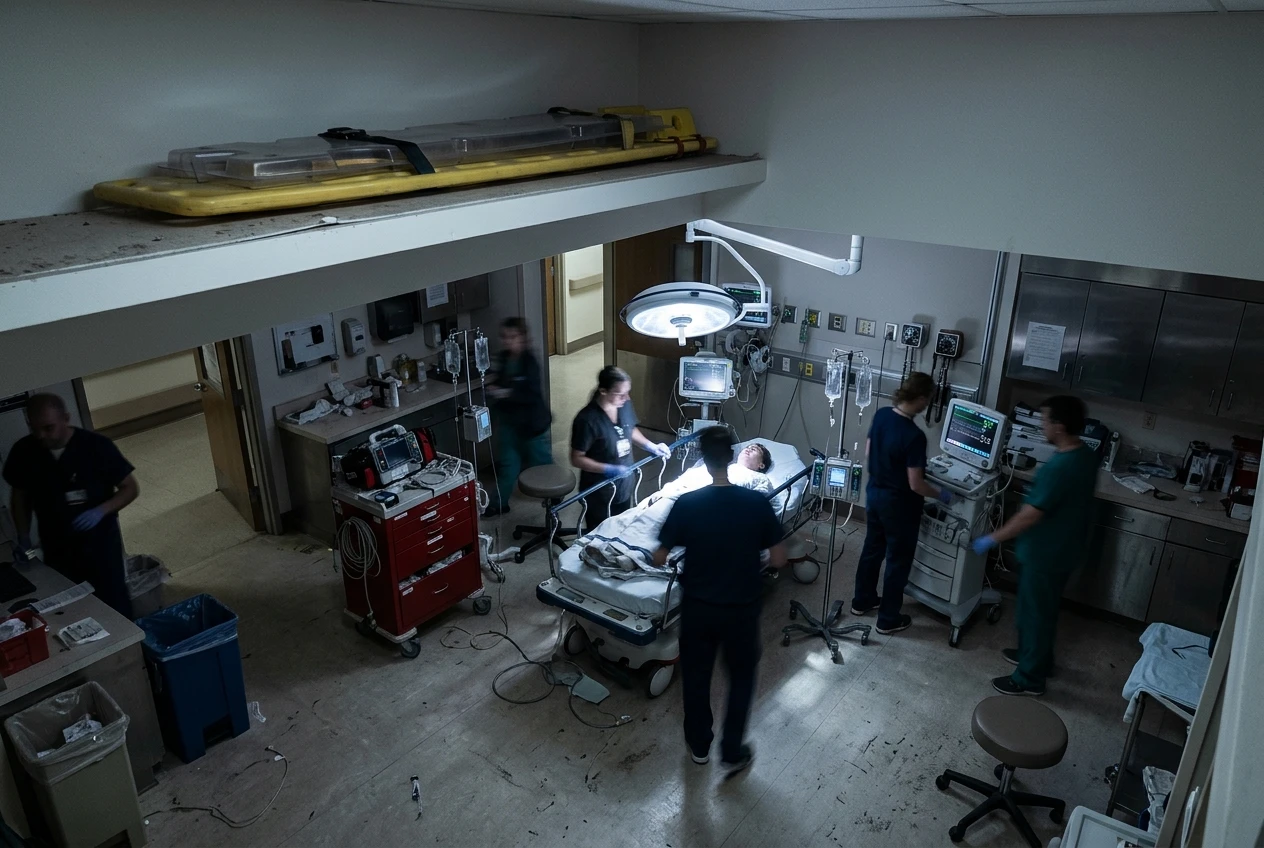
Some accounts include details about the room or the resuscitation that the person says they could not have known. These claims are hard to check. The AWARE study, led by Sam Parnia and published in 2014, placed hidden images on high shelves in hospital rooms to test whether anyone could really see from above. The few survivors who described an out-of-body sense did not report seeing the images, so the study did not confirm a verified sighting.
Skeptics point to brain research. In 2002, a team led by Olaf Blanke reported that electrically stimulating a region near the right angular gyrus in an epilepsy patient produced a sensation of floating and seeing her body from above. They suggest the brain can generate the feeling when it cannot combine signals from the body and the senses properly.
The tunnel, the light and the feeling of being welcomed
People often describe moving through a dark space toward a light, sometimes bright but not painful. Many say the light felt like it had a character: warm, loving and aware of them. The sense of being welcomed is often what stays with them, more than the visuals.
The tunnel is less universal than popular culture suggests. Some people report only a light, and others never mention one. Accounts from different cultures describe the passage in different terms, a point explored in the post on how cultural background shapes the way people interpret NDEs.
Skeptics note that tunnel vision happens when blood flow or oxygen to the eyes and visual cortex falls. Fighter pilots exposed to high G-forces in centrifuge tests report narrowing vision and sometimes bright lights before blacking out. A dying brain, the argument goes, could produce the same effect.
Meeting loved ones who have died, or a presence
Many people say they encountered relatives or friends who had died, sometimes people they had not known were gone. Others describe a presence, a guide or a being they cannot name, who communicates without words. In some accounts the figures seem to be waiting, and in others they simply appear and offer comfort.
Skeptics suggest hallucination shaped by memory and expectation. Dying brains may draw on the people we most want to see, and the experience gets reported through the beliefs the person already holds. Greyson has argued that these accounts differ from ordinary drug hallucinations, because they tend to be clearer, more organized and remembered in more detail afterward. Whether that difference means anything beyond brain activity is the point where researchers disagree.
Not every experience is comforting. A smaller number of people report fear, emptiness or distress. Researchers think these are underreported, since people may hesitate to share them.
The life review, seeing your life from the inside
In a life review, the person sees events from their life, sometimes in quick succession and sometimes in vivid details. What many describe as unusual is that they experience events from the other person’s side, feeling how their words or actions affected someone else. Some say the review contained no judgment, only understanding.

The idea has a long history. In 1892, Swiss geologist Albert Heim collected accounts from climbers who survived falls and reported their lives passing in front of them. So this theme is not limited to the modern NDE literature.
Skeptics link it to the memory regions of the temporal lobe, which can produce flashbacks when stimulated and are sensitive to oxygen loss. A surge of activity there under extreme stress could release a flood of memories. That explanation covers the replay of events. It is less clear on why some people describe feeling what others felt.
Deep peace, no sense of time and a point of no return
Many describe an overwhelming calm, with no pain and fear. Time often loses its meaning, so that a few minutes feel endless or the question of duration stops making sense. Some also describe reaching a boundary, such as a river, a gate or line, and understanding that crossing it would mean they could not return to physical life.

The decision to go back is a common element. Some say they were told to return, and others say they chose to because of children or unfinished tasks. People often describe returning to the body as a heavy and unwelcome shift.
Skeptics offer several explanations. Endorphins and other chemicals released under stress may produce calm and reduce pain. Some researchers, such as neurologist Kevin Nelson, argue that parts of REM sleep can intrude on waking consciousness during a crisis, blending dreamlike imagery with awareness. A study by Jimo Borjigin and colleagues found a burst of organized brain activity in rats after cardiac arrest, which she has proposed could underlie vivid experiences in humans. How well that applies to people is still being researched.
Coming back changed, the after-effects people report
The after-effects are among the best documented parts of the topic, because they can be followed over years. Many experiencers say they fear death less, care more about relationships and care less about status and money. Some report greater compassion, a stronger sense of purpose and more interest in spiritual questions, though not always in organized religion.
It is not always easy. Researchers, including Greyson, have documented that some people struggle to fit back into their old lives. Partners may not recognize the person they married, and some experiencers find that friends and family do not know how to respond. Others feel unable to explain what happened without being dismissed.
Skeptics say that surviving a life-threatening event is itself transformative, and that a near-death crisis would change anyone’s priorities whatever happened in the brain. Supporters answer that the shifts seem larger and more lasting than those seen in people who survive similar events without such an experience. That comparison is difficult to make cleanly, since the groups differ in many ways.
What skeptics say about the patterns, and where the debate stands
The explanations above share a common view: a brain under severe stress, low on oxygen and flooded with chemicals, can produce vivid, organized experiences. Some researchers also point out that people may reconstruct memories afterward, shaping them into familiar stories. The case that near-death experiences are a natural brain event is strong for individual elements, such as the tunnel, the calm and the memory flashes.
The harder question is whether those explanations cover the whole experience, particularly clear, structured awareness during cardiac arrest, when the brain’s electrical activity is expected to be severely disrupted. Researchers like Pim van Lommel, who published a prospective study of cardiac arrest survivors in The Lancet in 2001, argue that this needs a wider explanation. Others reply that brain activity may continue in ways that standard monitoring misses, or that experiences happen in the moments just before or after the arrest.
At present, no single theory has settled the matter. For a closer look at both sides, see the post on scientific explanations versus spiritual perspectives on NDEs.
Where to go next if you want to read the research yourself
Reading what experiencers say in their own words is a good way to see how the themes show up in real life. The interviews post is a good starting point. If you want to go deeper and learn more, Check out these interesting books below on Amazon:
- Life After Life by Raymond Moody, the book about living on after your Earthly life.
- Consciousness Beyond Life by Pim van Lommel, a cardiologist’s account of his cardiac arrest research and his argument for a broader view of consciousness.
- After by Bruce Greyson, a psychiatrist’s overview of decades of research, including the aftereffects.
- Erasing Death by Sam Parnia, which looks at resuscitation science and what people recall from cardiac arrest.
- Dying to Be Me by Anita Moorjani, a first-person account of her experience and recovery.
Pick one that matches the theme that interests you the most, and read it with the skeptics’ arguments in mind.
Some of the books above may link to Amazon, and if you buy through those links I may earn a commission at no extra cost to you. The commission helps me to continue research, writing and publishing. You can read exactly how that works on my affiliate disclosure page link.