

Most people assume the brain produces consciousness the way a stomach produces digestion. Neuroscience has mapped a great deal about which brain regions light up when we see, remember or feel pain. What it has not explained is why any of that activity comes with an inner experience at all. Philosophers call this the problem of consciousness.
A small group of scientists suspects the answer needs physics that goes deeper than neurons firing. Their reasoning is that if ordinary brain chemistry were the whole story, it should already have explained experience, and it has not. Quantum physics, which describes matter at the smallest scales, is the obvious place for them to look. Of the quantum consciousness theories, the best known is Orch OR.
This article takes that one theory apart piece by piece, shows where it connects to near death experiences, and says plainly where it stands. Orch OR is unproven and openly debated. Treat it as an idea worth understanding, not a settled result.
What Orch OR actually says: Penrose, Hameroff and the microtubule idea
Orch OR stands for Orchestrated Objective Reduction. It combines the work of two people from very different fields. Roger Penrose is a mathematical physicist who shared the 2020 Nobel Prize in Physics for his work on black holes. Stuart Hameroff is an anesthesiologist who spent his career studying how anesthetic drugs switch consciousness off.
Penrose started from a mathematical argument, laid out in his 1989 book The Emperor’s New Mind. He argued that human understanding cannot be fully reproduced by a computer following fixed rules, so something in the brain must work differently from computation. Many mathematicians and philosophers dispute that argument, but it is where the theory begins.
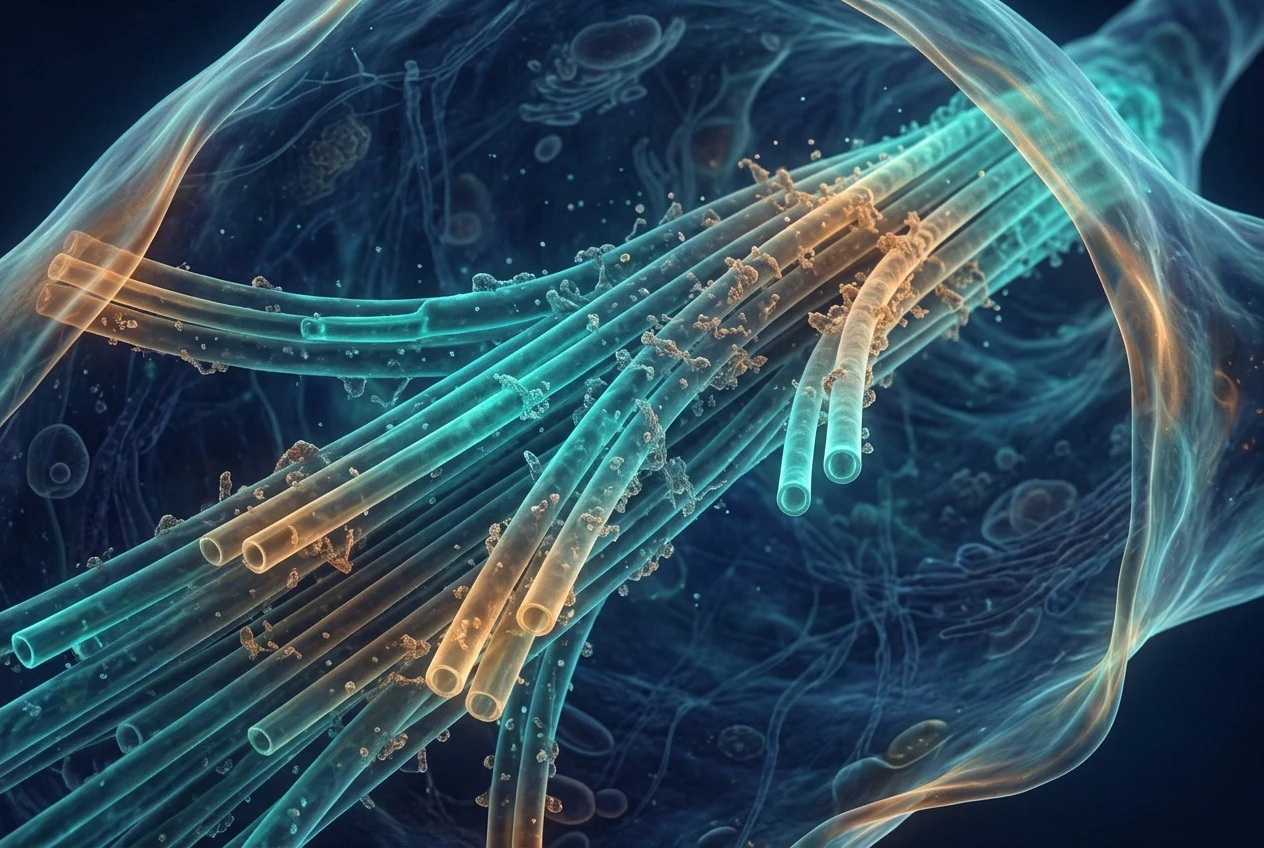
Hameroff supplied a possible physical location: microtubules. These are tiny tube-shaped protein structures inside every cell, including neurons. They are usually described as part of a cell’s internal scaffolding and transport system. Hameroff proposed that they could also support quantum processes, and that consciousness arises when those processes reach a particular kind of endpoint.
Quantum ideas in plain words: superposition and collapse without the math
You need two ideas to follow the theory:
Superposition means a quantum system can be in more than one possible state at once. A particle can exist as a spread of possibilities, not a single definite position, until something forces a result.
Collapse is what happens when that spread of possibilities resolves into one definite outcome. Standard quantum physics says collapse happens when the system is measured, but it does not agree on what counts as a measurement or why collapse occurs at all.
Penrose proposed that collapse is a real physical event that happens by itself once a system reaches a certain threshold related to gravity. He calls this objective reduction. In Orch OR, each of these collapses inside microtubules is a tiny moment of experience. “Orchestrated” means the brain’s biology organizes and times those collapses, and the theory holds that a stream of them adds up to the flow of conscious thought.
Where near death experiences fit into the theory
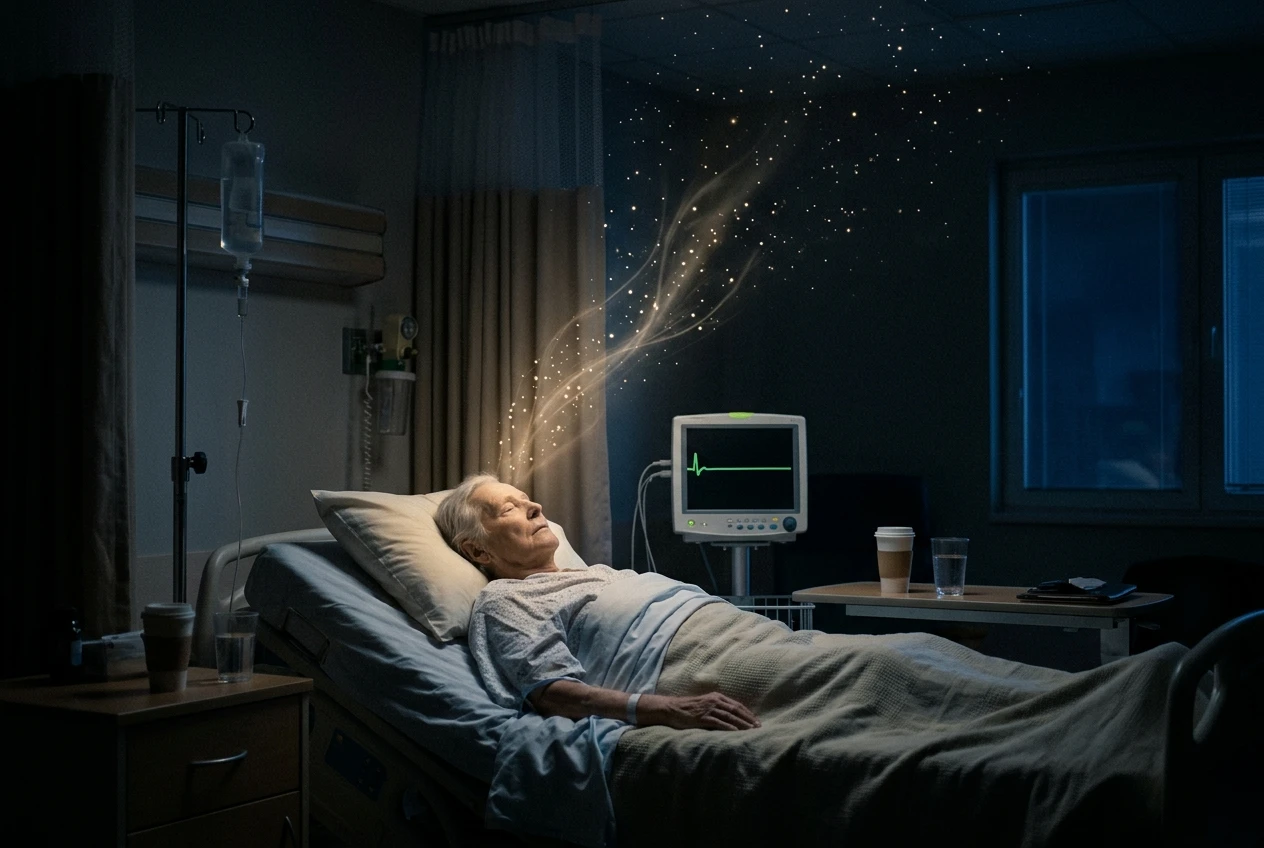
Orch OR was not designed to explain near death experiences, but Hameroff has applied it to them. His proposal runs like this. If consciousness is built from quantum information in microtubules, that information might not vanish when the heart stops and blood flow ends. Instead it could, in his words, leak out into the surrounding universe. If the person is revived, the information could return to the brain, and the person might report a vivid experience. If they die, it would remain outside the body.
This is a hypothesis about what could happen, not an observation. Nobody has measured quantum information leaving a brain. Its value for NDE research is that it offers a physical mechanism for how awareness could continue when the brain is failing, which is the thing many experiencers report. The usual reports include clear thinking, a sense of leaving the body, and encounters with light or other beings. For how those reports tend to unfold, see the nine near death experience stages.
Anesthesia is a second link. Hameroff argues that anesthetic gases act on microtubules, which would explain why very different chemicals all switch off consciousness. Mainstream anesthesiology generally describes drug action through receptors and ion channels on neurons, so this too is contested.
What critics say: the warm, wet brain problem and other objections
The most famous objection is about temperature. Quantum effects are fragile. They normally survive only in cold, isolated, carefully controlled conditions, because heat and contact with surrounding molecules destroy them, a process called decoherence. The brain is warm, wet and constantly busy with tons of different activities.
In 2000 the physicist Max Tegmark published calculations estimating that quantum states in neurons would fall apart within an extremely small fraction of a second, far too quickly to influence the timing of brain activity. Hameroff and his colleagues replied that Tegmark modeled the system incorrectly, and they offered calculations of their own that allowed much longer lifetimes. The argument has continued since.
Other objections include:
- The Gödel argument. Many logicians say Penrose’s reasoning about non-computable understanding contains gaps and does not show what he claims.
- Unnecessary complexity. Some neuroscientists argue that known brain processes may eventually explain consciousness without quantum mechanics, so adding it is premature.
- The role of microtubules. Critics note that microtubules are found in all kinds of cells, including ones that show no sign of consciousness, and ask why they would matter here.
- The NDE leap. Even if Orch OR were true, it would not automatically show that information survives death. That step is an extra hypothesis.
Where the evidence stands today and what remains unproven
Orch OR is a minority position in neuroscience. It is taken seriously enough to be debated in journals and at conferences, but it has not been confirmed, and most researchers in the field do not accept it.
Supporters point to some experimental work. A 2024 study in rats reported that a drug that stabilizes microtubules delayed the onset of anesthesia. Supporters read that as consistent with a role for microtubules in consciousness. Critics respond that the result is indirect and has other possible explanations. It does not demonstrate quantum processes in the brain.
Several things remain unproven:
- That quantum states last long enough in living neurons to matter.
- That collapse events in microtubules correspond to moments of experience.
- That any information leaves the brain at death.
- That reports from near death experiences reflect anything beyond brain activity under extreme stress.
The theory makes claims that can in principle be tested, which is a point in its favor. Testing them in conscious brains is very hard.
What it would mean if consciousness reaches beyond the brain
Suppose, for the sake of argument, that Orch OR or something like it turned out to be right. Consciousness would then be tied to basic processes in physics, not only to the wiring of neurons. The brain would still matter a great deal, but as a structure that organizes and focuses experience, is not the only thing that produces it.
For near death research, that would change how some reports are read. Accounts of clear awareness during cardiac arrest, when brain activity is expected to be severely disrupted, would be harder to dismiss as simple malfunction. It would not prove that anything survives death, and it would not settle the spiritual questions. It would make them legitimate subjects for scientific study.
If the theory is wrong, the NDE question stays open all the same. Researchers continue to look at oxygen loss, anesthesia, memory and expectation as possible explanations. The existing post on scientific explanations versus spiritual perspectives on NDEs lays out that wider debate, and it is a good next read if you want the broader picture.
Books and tools for exploring consciousness further
Reading the original sources is the best way to judge these ideas for yourself. These books cover the theory and the NDE evidence from different angles:
- The Emperor’s New Mind by Roger Penrose. This is where Penrose lays out his argument about computation and the mind. Parts of it are demanding, but it is the primary source.
- Shadows of the Mind by Roger Penrose. The follow-up that develops the argument further and introduces the microtubule link with Hameroff’s work.
- Consciousness Beyond Life by Pim van Lommel. A cardiologist’s account of near death experiences during cardiac arrest, with his view that consciousness may not be produced by the brain alone.
- After by Bruce Greyson. A psychiatrist who has studied near death experiences for decades describes what they reveal and what researchers still do not know.
Reading one book from the physics side and one from the NDE side shows you how differently the two fields frame the same question.
If you buy a book through an affiliate link on this site, the site may earn a commission. The full details are in the affiliate disclosure.