

Stories of persons seeing “the other side” following clinical death have both captivated and puzzled us throughout human history. These Near-Death Experiences (NDEs) cases frequently have strikingly similar themes, such as traveling through tunnels, seeing dazzling light, seeing departed loved ones, or experiencing a deep sense of peace and separation from the body. However, what really is going on in the brain at these times?
We are now closer than ever to comprehending the part that brain activity plays during NDEs due to advances in brain science, psychology, and theory of mind, but the riddle is still far from resolved. The relationship between the brain and consciousness in experiences of near-death is examined in this article along with the most recent scientific findings, speculations, and discussions.
Understanding Near-Death Experiences
It’s important to define what researchers mean by a “near-death experience” before delving into the neuroscience. In his ground-breaking book Life After Life, published in 1975, psychiatrist Dr. Raymond Moody introduced the term by describing the typical experiences of individuals who are resuscitated following clinical death.
There have been thousands of instances reported globally thereafter.
Some typical characteristics of NDEs are:
- A sense of leaving the body and floating up, viewing oneself from above
- Moving through a tunnel toward a light faster than the speed of sound
- Intense feelings of peace or love
- Encounters with deceased relatives or spiritual beings
- A “life review,” where one re-experiences key life moments
- Reluctance to return to the physical body due to the strong feelings of peace and love
Many people question whether the experience represents an actual separation of consciousness from the brain—or a distinct neurological phenomenon that occurs during dying—because the core elements seem universal despite cultural differences.
What Happens to the Brain at Death’s Door?
A number of vital biological processes happen quickly one after the other as the body prepares for death. Reduced blood flow to the brain deprives neurons of oxygen and glucose, which are vital fuels. Electrical activity becomes erratic as a result, causing chaotic brain wave bursts.
Researchers researching cardiac arrest have discovered that the electrical signals in the brain usually diminish 10 to 30 seconds after the heart stops beating. But new research indicates that something more complicated may be taking place.
According to a 2013 University of Michigan research that was published in the Proceedings of the National Academy of Sciences, rats who were going through cardiac arrest showed a huge spike in high-frequency brain activity in the seconds that followed. This spike, referred to as gamma wave activity, is usually linked to increased memory formation and conscious perception.
This unexpected interesting finding suggests that the brain may become hyperactive right before it shuts down, which could result in strong, dreamlike experiences that resemble those seen in near-death experiences.
The Gamma Wave Connection
With a frequency range of 30 to 100 Hz, gamma waves are the quickest of all brainwave frequencies and are important in the merging of data from many areas of the brain. They are also associated with complicated thinking processes, sensory binding, and increased awareness.
Some neuroscientists speculate that a final, strong surge of gamma wave synchronization during an NDE, when a person recalls seeing their life flashing before their eyes or experiencing a sense of unity and clarity, may be the result of the brain’s last attempt to comprehend or maintain information under extreme pressure.
A strikingly identical observation was made in 2023 by academics who were monitoring dying human patients in intensive care facilities. Even after heart the function stopped, terminally ill patients’ brain scans (EEGs) displayed short bursts of coherent gamma activity. These brief outbursts demonstrated that the brain goes through a complicated and perhaps conscious shutdown process rather than just simply shutting off like a lamp.
This has led researchers to speculate that the extreme clarity and reality that define near-death experiences may be produced by the last moments of brain activity.
The Dying Brain and Oxygen Deprivation
Oxygen deprivation, or hypoxia, for short, is another popular theory for NDEs. Vision blurs and peripheral sight declines when the brain is oxygen-starved, producing a tunnel sensation comparable to “moving toward the light.”
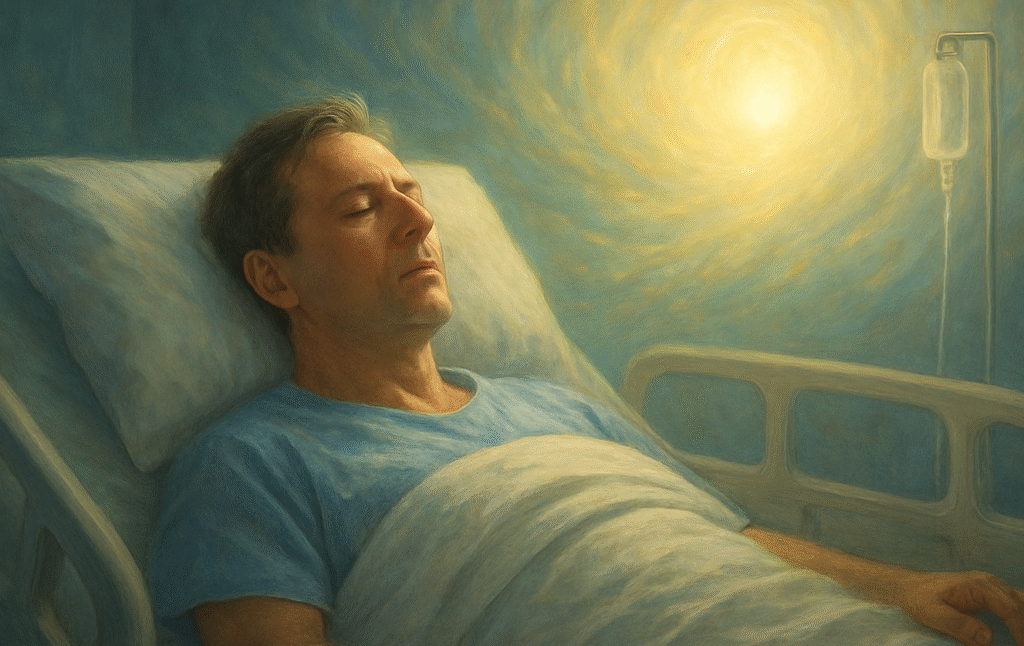
Neurotransmitters like dopamine and endorphins can also be released in response to oxygen deprivation, which could account for the frequently observed feelings of calm and joy. Furthermore, DMT (dimethyltryptamine), a potent psychedelic substance that occurs naturally in the body, may be released in spikes from the brain. According to some research, the pineal gland or other brain structures may release more DMT in severe situations, which could result in vivid, unearthly imagery that is compatible with near-death experiences.
True experiences—situations in which people claim seeing events that were later confirmed, like conversations or surgical details seen while they were clinically unconscious—are not entirely explained by this theory, despite the fact that it explains many sensory components of NDEs.
Out-of-Body Experiences and the Brain
The out-of-body experience (OBE), which is the feeling of floating above one’s body and witnessing events from an outside perspective, is the most puzzling aspect of many NDEs.
Much progress has been made in neuroscience to understand how these sensations might occur. Researchers at the University Hospital of Geneva found that activating the temporo-parietal junction (TPJ), a particular area of the brain, might cause sensations of floating or looking up at oneself.
The integration of sensory data about touch, vision, and body location is heavily reliant on the brain’s TPJ. It may appear as though the mind and body are separate when this integration is disrupted—for example, by trauma, oxygen deprivation, or electrical volatility.
This does not imply that OBEs are psychologically “false,” but instead suggests that the brain may produce experiences that seem incredibly real, even when they don’t match up with actual physical occurrences.
The Consciousness Question: Does Experience Come from or Go Through the Brain?
Many academics and experts contend that brain-based ideas fall short of providing a complete picture, even in light of these scientific reasons. The primary debate is still whether consciousness is a result of brain activity or if consciousness exists independently and is filtered or received by the brain.
Some NDEs involve validated experiences that happened during flatline EEG periods, when the brain should not have been able to produce conscious consciousness, according to proponents of the latter theory, which include notable scientists like Dr. Pim van Lommel and Dr. Bruce Greyson.
Survivors of cardiac arrest who recalled vivid events, including precise specifics of their medical resuscitation—information confirmed by hospital staff—were the subject of Van Lommel’s seminal 2001 study, which was published in The Lancet. The idea that consciousness might endure apart from detectable brain activity has been strengthened by such data.
According to this theory, the brain works more like a biological connection that adjusts awareness to the outside environment, much like a transceiver. During near-death experiences, when the brain briefly shuts down, awareness may “unplug” from physical restraints and experience reality in a broader, wider manner.
The Philosophical and Ethical Implications
In addition to providing insight into the dying process, knowledge of brain activity during NDEs brings to question our conceptions of life, mortality, and self-awareness.
Death might not be an immediate event but rather a prolonged shift in which the body and mind gradually separate if certain types of consciousness can happen during cardiac arrest. This idea impacts end-of-life care ethics, organ donation procedures, and medical definitions of death.
In terms of theology, the question of whether consciousness depends entirely on the brain is at the core of the mind-body paradox, which has been debated since Descartes and beyond. According to dualist or non-materialist conceptions, the brain only channels a more basic kind of awareness, while materialist models contend that consciousness is the result of sophisticated brain computation.
NDE research is, in any case, forcing both sides to reevaluate their presumptions.
Linking Spirituality and Science
The subjective nature of NDEs—their enduring emotional and spiritual impact—suggests something more than just neurological noise, even though the neuroscientific data leads to fascinating physiological mechanisms. After their experiences, survivors frequently talk about significant changes, such as a decrease in their fear of dying, an increase in compassion, and an improvement in their intuitive abilities or creativity.
These alterations suggest that whatever happens during NDEs is more than a mental illusion. It is yet unknown if these changes are caused by interaction with a higher awareness or are naturally imprinted through changed brain pathways.
By integrating brain imaging, controlled visual tests during resuscitation, and EEG monitoring, contemporary research projects like Dr. Sam Parnia’s AWARE (AWAreness during REsuscitation) investigations continue to look into this subject. According to initial results, certain patients may continue to show detectable patterns of brain activity even after they have passed away, opening up a new avenue for research into the relationship between biology and consciousness.
Conclusion: The Mystery Continues
One of the most profound areas of research in both philosophy and science is the role of brain activity during NDEs. Numerous parts of near-death experiences may be explained by evidence of remarkable neurochemical and electrical events that take place when the brain shuts down, including surges in neurotransmitters, lack of oxygen effects, and bursts of gamma activity.
However, the idea that consciousness ends when the brain does is questionable by the ongoing perception of awareness that transcends measurable brain activity. As of right now, science can explain the “how” of NDEs—the brain’s remarkable last performance—but not entirely the “why.”
We may be able to determine if the light at death’s door is a neuronal illusion or a real window into the next realm of life as technology develops and our knowledge of consciousness grows.