
Consciousness theories make up one of the most fascinating and hotly debated areas in both science and philosophy. Questions like “what is consciousness?” and “how does it emerge from the brain?” keep researchers, neuroscientists, and armchair philosophers talking for hours. Figuring out what happens in our minds when we’re aware of ourselves and the world is no easy feat. I’m going to walk you through the main ideas, the most popular theories, some practical ways scientists try to study this mystery, and the hurdles that come up along the way.
The Big Picture: Why Consciousness Theories Matter
People often wonder why there’s such a fuss about consciousness. The thing is, consciousness is basically the lens through which we experience everything, from a sunrise to catching up with a friend. It’s pretty wild that nobody fully understands how the brain creates this sense of being “awake inside.” Scientists and philosophers have spent years trying to pin down what actually causes consciousness, and why it feels the way it does.
There’s more at stake here than just fancy talk. Different theories about consciousness actually shape how we treat brain injuries, understand mental health, design artificial intelligence, and even approach ethics. For instance, if we ever crack the code of consciousness, building conscious machines could be much closer than anyone thought a decade ago. Meanwhile, unlocking how consciousness happens helps doctors track down what’s going on in conditions like coma or locked-in syndrome. People’s daily lives, moral decisions, and even technology would all get a boost if we got a handle on consciousness.
Main Types of Consciousness Theories
Most theories about consciousness fall into a few broad groups. Each one has its own take on how and why conscious experience exists. So, let’s now have a look at the approaches you’ll run into the most.
- Dualism: The classic idea that the mind and body are two separate things. This was made famous by René Descartes (“I think, therefore I am”). Dualists believe that mental stuff and brain stuff work together, but are totally different in kind.
- Materialism (Physicalism): This group sees consciousness as coming straight from physical processes in the brain, with no separate “mind stuff” needed. Most current scientific theories fit here.
- Panpsychism: This is much less mainstream, but it’s having a bit of a comeback. Panpsychism suggests that some tiny bit of consciousness might be present in all matter, even in atoms and electrons. Everything adds up to bigger forms of consciousness.
- Functionalism: The view that consciousness is defined by what it does, not what it’s made of. If something (like a computer or an alien brain) does the right kind of mental work, it would count as conscious.
Popular Scientific Theories Explained
Researchers have put forward several detailed theories that try to explain exactly how the brain generates conscious experience. Here’s a quick rundown of some you’ll hear about most:
- Global Workspace Theory (GWT): Proposed by Bernard Baars and developed further since, this model describes the brain like a giant stage. Plenty of brain processes go on backstage, but only a few make it to “center stage”; these are the thoughts, feelings, or perceptions you’re consciously aware of. The “spotlight” of awareness is the global workspace.
- Integrated Information Theory (IIT): Started by Giulio Tononi, IIT says consciousness is about how much a system’s parts work together in a unified way. The more interconnected and irreducible information a system generates, the higher its level of consciousness. This idea is often represented by the symbol Φ (phi).
- Higher-Order Thought (HOT) Theory: This approach says a mental state doesn’t become conscious until you have a thought about it. For example, seeing the color red is just one thing, but only when you’re also aware that you’re seeing red does the experience become conscious.
- Recurrent Processing Theory: This view focuses on looping feedback in neural circuits. Early brain responses happen unconsciously, but when signals loop back through higher and lower brain areas, that’s when conscious awareness arises.
Comparison of Popular Consciousness Theories Explained by A Chart
| Theory | Primary Focus | Key Concept Explained Simply |
|---|---|---|
| Global Workspace Theory (GWT) | Information broadcasting | Consciousness acts like a stage where information is broadcast to different parts of the brain for processing |
| Integrated Information Theory (IIT) | Complexity and integration | Consciousness arises from how much and how well information is integrated, measured using mathematical models |
| Higher-Order Thought Theory (HOT) | Metacognition and self-reflection | A mental state becomes conscious when we are aware that we are having that mental state |
| Recurrent Processing Theory | Neural feedback loops | Consciousness emerges from feedback signals looping between different brain regions |
If you’re curious, some recent experiments using brain scans have found patterns of “ignition” in the brain—bursts of neural activity that seem to line up with the global workspace idea. Other research has worked to measure the “phi” level in various systems, coming up with ways to sort different states of consciousness, such as sleep, anesthesia, or even animal awareness.
How Scientists Study Consciousness
Digging into something as slippery as consciousness isn’t easy, but scientists keep finding clever ways to measure and poke at it. Here’s what’s usually involved:
- Brain Imaging: MRI, fMRI, PET scans, and EEG all give researchers a peek at which parts of the brain light up when we do things like see a face or think about lunch.
- ReportBased Tests: Participants might be asked if they noticed a flashing light or a faint sound, to see when awareness clicks in.
- Masking Techniques: Quick and careful tricks, like “backward masking,” where a strong image hides another image from conscious awareness. Scientists can compare the brain activity for seen versus unseen images.
- Comparing Different States: Looking at brain activity while people are awake, asleep, under anesthesia, or in a coma reveals what changes when consciousness goes “offline.”
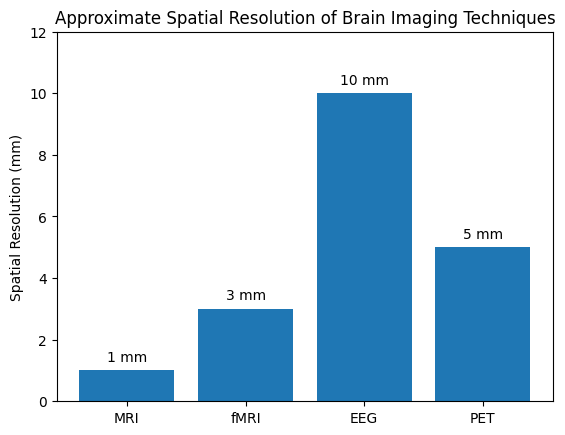
Bar Chart: Common Brain Imaging Techniques Used in Consciousness Research
What the measurements represent
These values show how precisely each technique can localize brain activity or structure (smaller = more precise):
- MRI — ~1 mm
High structural detail; excellent for anatomy - fMRI — ~3 mm
Measures brain activity indirectly via blood flow (BOLD signal) - EEG — ~10 mm
Excellent timing, but poorer spatial localization due to signal spread across the scalp - PET — ~5 mm
Detects metabolic activity, but with lower spatial precision than MRI/fMRI
Some labs even use cuttingedge technology such as transcranial magnetic stimulation (TMS) to prod the brain and see what moments of awareness result. There’s growing interest in “neural correlates of consciousness,” looking for the minimum brain activity needed for any awareness. Understanding individual differences in conscious experience is another big focus, which has implications for everything from education to mental health care.
RealWorld Examples and Applications
I’ve noticed that figuring out what consciousness is has some pretty practical payoffs, even outside philosophy debates. For example, doctors use theories of consciousness to help judge whether someone in a coma might recover. The same ideas that drive artificial intelligence research, like “can a robot ever be conscious?”, are based on how we define awareness in humans.
- Medical Diagnostics: Scales such as the Glasgow Coma Scale use answers to stimulus and brain activity to check levels of awareness.
- AI and Robotics: Developers use theories like functionalism and global workspace when designing smart assistants and selfdriving cars, making sure they handle information in a way that’s “aware,” even if they’re not conscious in the human sense.
- Animal Welfare: Knowing which animals have conscious experiences shapes how we treat pets and livestock. Some countries have started to legally recognize the consciousness of certain animals, changing laws on animal treatment as a result.
In fact, how we label consciousness affects everything from treating depression (where patients may report being “numb” or cut off from feelings) to initiatives in animal rights and even in legal discussions when granting nonhuman entities special status.
Challenges and Debates in Studying Consciousness
I run into plenty of tough questions as I dig deeper into consciousness theories. Here are some common headaches researchers keep arguing about:
- The Hard Problem: Coined by philosopher David Chalmers, the “hard problem” asks why brain activity comes with the feeling of awareness at all, rather than just processing like a computer. Science is great at mapping neurons and synapses, but is not so great at explaining the “inside view.”
- Subjectivity: Consciousness is private, so there’s no way to truly peek into another person’s experience. That makes direct measurements tough and raises doubts about whether machines could ever be conscious.
- Defining Terms: Folks even disagree about what “consciousness” really means; does it cover all awareness, only selfreflection, or only certain mental states?
- Ethical Implications: If animals, infants, or even computers have some sort of consciousness, how should we treat them? Lines aren’t always clear.
There’s also an ongoing debate about how findings in neuroscience really connect the dots between brain circuits and personal experience. Many scientists believe that we may be missing key pieces or using models that are too simple for such a complex phenomenon.
Pie Chart: Major Focus Areas in Consciousness Research
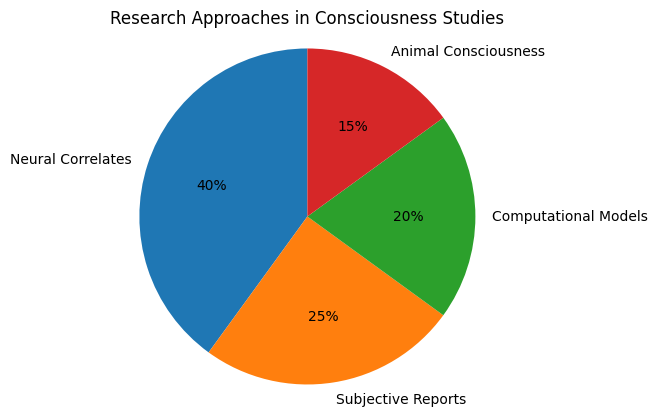
This above chart information clearly visualizes how the following research focus is distributed:
- Neural correlates — 40%
- Subjective reports — 25%
- Computational models — 20%
- Animal consciousness — 15%
Frequently Asked Questions
Lots of people have questions when they get curious about consciousness. Here are a few that come up a lot:
Can consciousness exist outside the brain?
Most mainstream science points to the brain as the seat of consciousness, though dualists and some religious thinkers believe the mind could exist separately or survive death.
Is artificial intelligence conscious?
Today’s AI can process information and mimic certain behaviors, but there’s no good evidence that digital systems actually have a sense of “self” or subjective experience.
How do scientists measure consciousness?
They use brain scans, behavioral tests, and people’s own reports to get a handle on what’s going on. But because consciousness is private, there’s still plenty of debate.
Which animals are conscious?
There is increasing evidence that many mammals, some birds, and even octopuses have levels of awareness. Definitions vary, and scientists are still working to agree on clear criteria, but behaviors like problem solving, communication, and emotional responses offer clues.
My Final Thoughts
Consciousness theories keep going through a glowup as science learns more about the brain and mind. Each new experiment brings us closer to figuring out what makes experience feel the way it does. No single theory has the whole answer yet, but by looking at all the options, I get a better sense of just how mysterious and exciting the quest to understand consciousness really is. The next time you wonder what’s going on inside your own head, remember—this mystery is at the very heart of what it means to be alive and aware.